
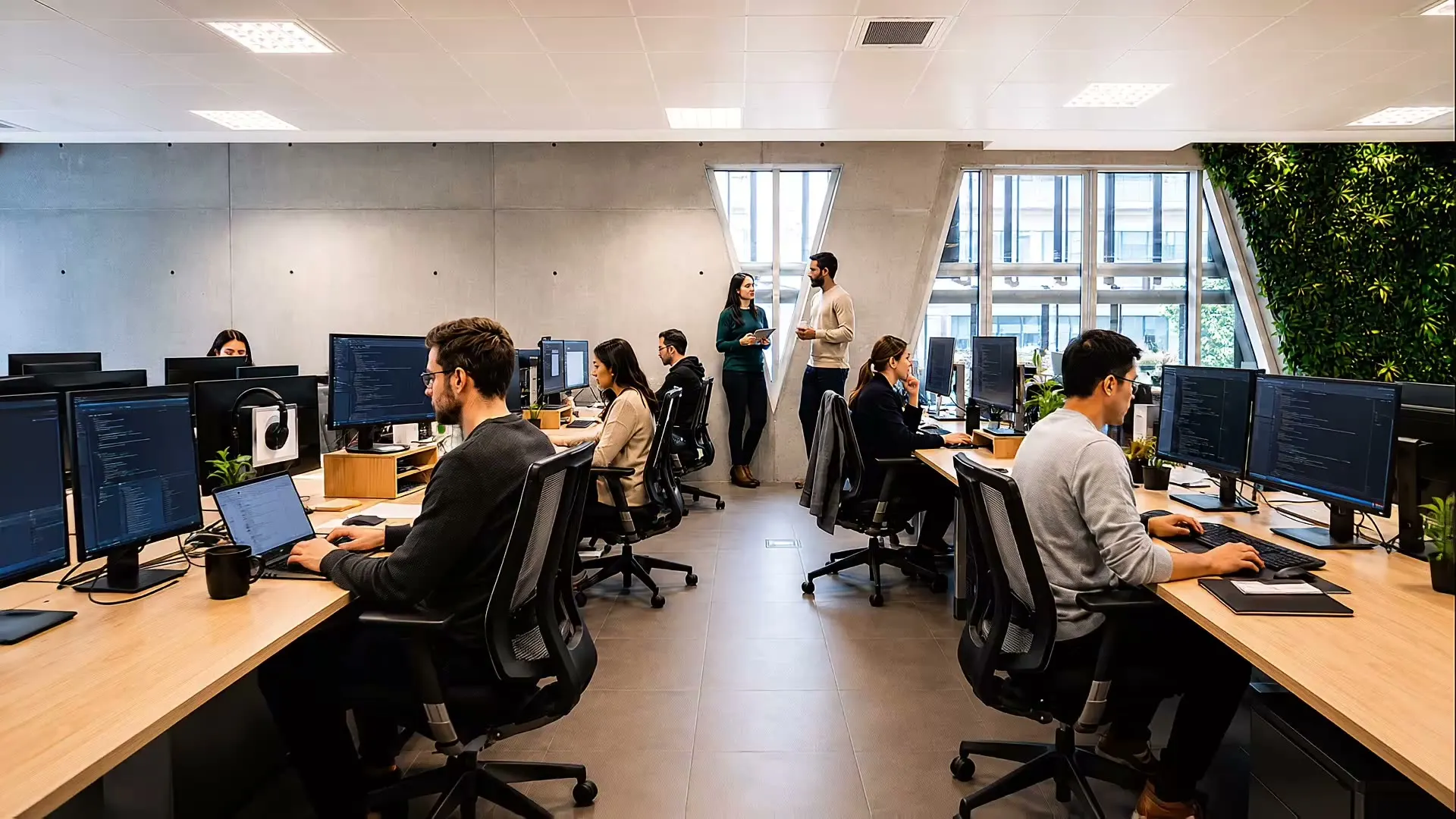
Nearshore software development in Portugal, built around your roadmap.
Senior engineering capacity in European-hours, integrated into your delivery process, with the control and communication that offshore models often make harder to maintain.
What nearshore software development means.
Nearshore software development means building software with engineers in a nearby country and timezone, rather than locally (onshore) or far away (offshore).
The gap that matters is not only distance on a map. It is how much of the working day, culture and process you actually share with the team.
For European companies, Portugal is a strong nearshore location, close enough to share the working day and set up for how European teams build software.
High working day overlap
A nearly full shared workday with the UK and Central Europe, so standups, reviews and decisions happen live.
EU and GDPR alignment
Inside the EU legal framework, so data stays in Europe and contracts sit under familiar rules.
Strong English communication
Fluent, everyday English across the team, so briefs, pull requests and calls land without friction.
Experienced engineering talent
A deep pool of senior engineers from a mature tech ecosystem, not just extra hands.
Nearshore, offshore or onshore: what actually differs.
Local team, highest cost.
Portugal — cost and control, balanced.
Lowest headline, more coordination.
Why nearshore still fails.
Overlap on the clock is necessary, not sufficient. Even with engineers in European hours, nearshore goes wrong when:
The team is not selected carefully enough for the work.
There is no governance, so delivery drifts.
Engineers sit outside the client's process and tools.
Reporting and ownership stay unclear.
How Xpertsoft makes nearshore work.
Senior profile matching
Matched to your stack and the work, not CV volume.
Engineers embedded in your process
Inside your tools, rituals and standards, not adjacent to them.
Governance and reporting
Built into the engagement, so delivery stays visible.
Backed by Findmore Group
Recruitment depth and operating experience behind every team.
When nearshore makes sense.
A good fit when
- You need to scale engineering capacity faster than local hiring allows.
- You want more control than a distant offshore model gives you.
- Your team needs strong timezone overlap.
- You have a roadmap that needs sustained delivery capacity.
- You want flexibility without building every role in-house.
When it may not be the right fit
- You need everyone physically co-located.
- You are only optimising for the lowest hourly rate.
- You do not have enough internal clarity on priorities, ownership or governance.
Why Portugal works for European teams.
Working-hours overlap
Strong overlap with the UK and Central Europe. Standups, reviews and incident response happen in real-time, not on a half-day delay.
EU and GDPR alignment
As an EU member state, data protection, contracts and IP sit inside the same legal framework as your European operations.
Strong English and cultural proximity
English is widely spoken in the engineering community, and the cultural distance to UK and Central European teams is low.
A strong technical talent pool
A solid engineering education base and an active tech ecosystem, with experienced developers across the modern stack.
Three ways to build a nearshore team.
Staff augmentation
Best when you already have leadership and rituals in place, but need senior capacity faster than hiring can provide.
Learn moreDedicated team
Best when you need a stable squad around a roadmap, with context that compounds over time.
Learn moreEnd-to-end delivery
Best when you want Xpertsoft to own a project or workstream while keeping visibility and governance.
Learn moreCapabilities across the stack.
Engineering
Frontend, backend, full-stack and mobile engineers who extend your delivery capacity across the product stack.
Quality and reliability
QA automation, DevOps, cloud and observability profiles that help teams ship with confidence.
Product and intelligence
UX/UI, product analysis, data and AI profiles for teams building more complex digital products.
Capacity, without giving up control.
Teams rarely move from offshore to nearshore for cost alone. They move because control, communication and delivery rhythm start to matter more than the lowest headline rate. With Xpertsoft, you keep technical leadership and direction. Engineers work inside your process, rituals and tools, and reporting stays on your terms. You add capacity without handing over how the work gets done.
Questions about nearshore.
What is nearshore software development?
Building software with engineers in a nearby country and timezone, rather than onshore (local) or offshore (distant). For European companies, Portugal offers high working-hours overlap with lower cost than local hiring.
How is nearshore different from offshore?
The difference is overlap and control. Nearshore gives you near-full working-hours overlap, strong communication and delivery you can keep control of. Offshore trades that for a lower headline cost.
Why Portugal for nearshore?
European working-hours, EU and GDPR alignment, strong English, and access to a strong technical talent pool, with the backing of the Findmore Group.
Is nearshore cheaper than hiring locally?
Typically lower than onshore hiring, while keeping European-hours overlap. We do not lead on price. We lead on seniority and control.
How do we keep control of delivery?
You keep technical leadership and direction. Engineers work inside your process, rituals and tools, with reporting on your terms.
Can nearshore engineers work inside our tools and process?
Yes. Engineers work inside your tools, rituals, access controls and delivery process, so reporting and visibility stay on your terms.
Is nearshore software development only for large companies?
No. It works for scale-ups, product companies and enterprise teams, as long as there is enough clarity on the roadmap, ownership and team structure.
How fast can we start?
We typically present a shortlist within 2 to 4 weeks, depending on role and stack. The full start then depends on interviews, approvals and onboarding on your side.
Which engagement model should we choose?
Staff augmentation to add people under your lead, a dedicated team for sustained work on a roadmap, or end-to-end delivery to hand over a workstream. The team builder can help you compare.
Is our data safe?
Engineers work within an EU and GDPR-aligned environment, under your access controls and security policy.
Build your nearshore team in Portugal.
Tell us the roadmap and the gap. We map the right model and the right engineers.
The right model for your situation
- Need people inside your team? Staff augmentation.
- Need a stable squad around a roadmap? Dedicated team.
- Need someone to own a workstream? End-to-end delivery.
A 30-minute call, no commitment.
Tell us the roadmap and the gap. We come back with the team shape that fits, not a pitch.